📖 What's in This Guide
⚠️ IMPORTANT: Not All 1776–1976 Half Dollars Are Equal
The bicentennial half dollar was struck at three mints in two compositions (clad and 40% silver) with two reverse types. A common circulated clad coin is worth 50 cents. A silver proof, high-grade collector specimen, or rare error can be worth hundreds to thousands. The mint mark and edge are the first things to check.
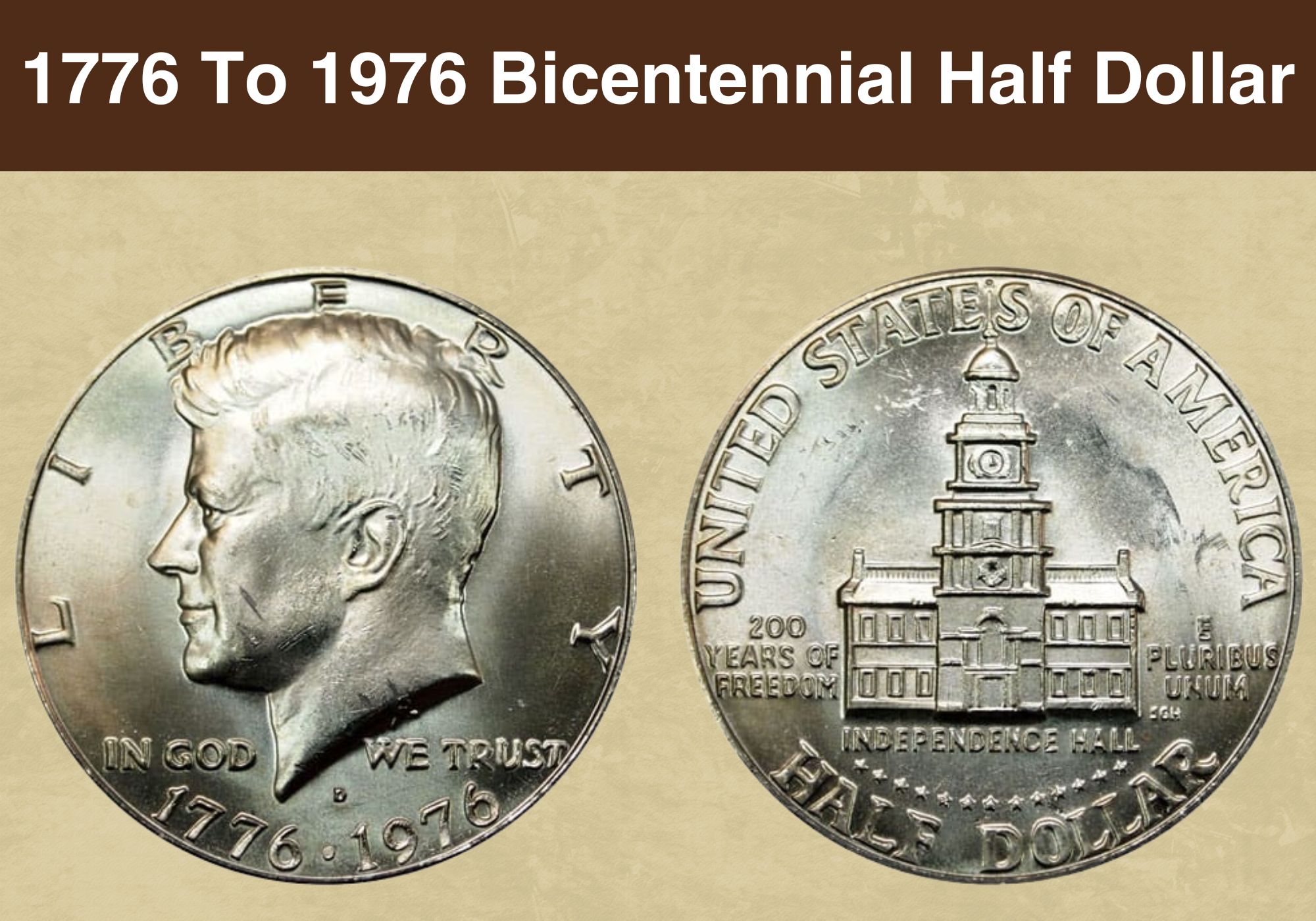
How to Identify a 1776–1976 Bicentennial Half Dollar:
- ✓ Kennedy portrait on the obverse (front)
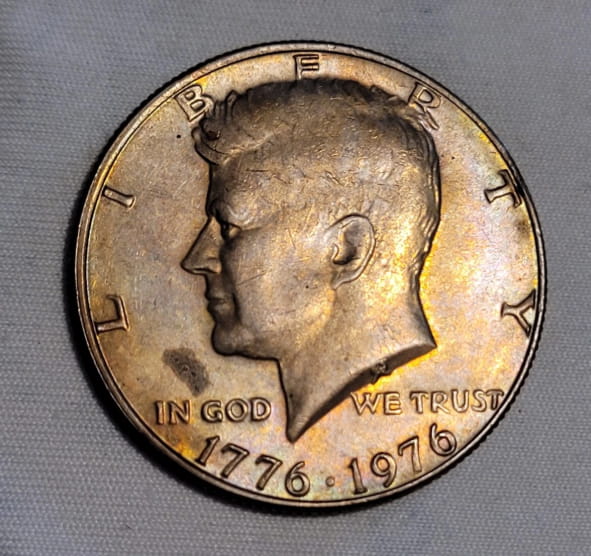
- ✓ Dual date "1776–1976" to the right of Kennedy — unique to bicentennial year
- ✓ Mint mark below Kennedy's neck — no letter = Philadelphia, "D" = Denver, "S" = San Francisco
- ✓ Independence Hall on the reverse (back) — designed by Seth Huntington
- ✓ Check the edge — copper stripe visible = clad (11.34g); solid silver edge = 40% silver (11.5g)
- ✓ Type 1 vs Type 2 reverse — bold blocky letters (Type 1) vs thinner serif letters (Type 2)
Bicentennial half dollars were struck from 1975–1976 but all carry the dual date 1776–1976. No 1975-dated half dollars exist.
The 1776–1976 Kennedy half dollar is one of the most widely recognized coins in American numismatic history. Struck to celebrate the nation's 200th birthday, hundreds of millions were produced — but buried within that enormous mintage are rare silver specimens, dramatic minting errors, and high-grade survivors worth far more than their face value.
Understanding 1776 to 1976 half dollar value starts with two questions: Is it silver or clad? And does it have an error? The answers can be the difference between 50 cents and $5,000.
"Most bicentennial half dollars in circulation are worth exactly 50 cents. But a silver proof, a major doubled die, or a wrong-planchet error can turn that same coin into a four-figure collectible. The edge test takes three seconds."
The 30-Second Bicentennial Half Dollar Quick Check
Before you get excited — or disappointed
The Bicentennial Half Dollar Traffic Light System
Red = Worth face value ($0.50–$5)
Clad, circulated, no mint mark or D mint mark — common coin from circulation
Yellow = Worth investigating ($5–$100)
S mint mark, silver composition, uncirculated clad, or proof specimen
Green = Jackpot potential ($200–$5,000+)
Major doubled die, off-center error, wrong planchet, or silver proof in top grade — do NOT spend
Table 1: Bicentennial Half Dollar — First Glance Value Indicators
| What to Look For | Where to Find It | What It Means | Value Range |
|---|---|---|---|
| Copper stripe on edge | Coin's edge | Clad composition | $0.50–$5 |
| Solid silver edge / 11.5g | Edge + scale | 40% silver composition | $8–$100+ |
| No mint mark | Below Kennedy's neck | Philadelphia Mint (clad only) | $0.50–$3 |
| "D" mint mark | Below Kennedy's neck | Denver Mint (clad only) | $0.50–$3 |
| "S" mint mark | Below Kennedy's neck | San Francisco — silver or clad proof | $5–$200+ |
| Doubled lettering or dates | 1776-1976, LIBERTY | Doubled die error | $100–$3,000+ |
| Bold blocky reverse letters | HALF DOLLAR text | Type 1 variety | Slight premium over Type 2 |
👉 Reality Check:
Over 520 million bicentennial half dollars were minted across three facilities. The vast majority are clad and worth face value. But — the S-mint silver versions, proof specimens, and error coins hidden in that enormous mintage are genuinely valuable. The edge test is free and takes three seconds.
Silver vs Clad, Mint Marks & Type Varieties Explained
Three mints, two metals, two reverse types — the full breakdown
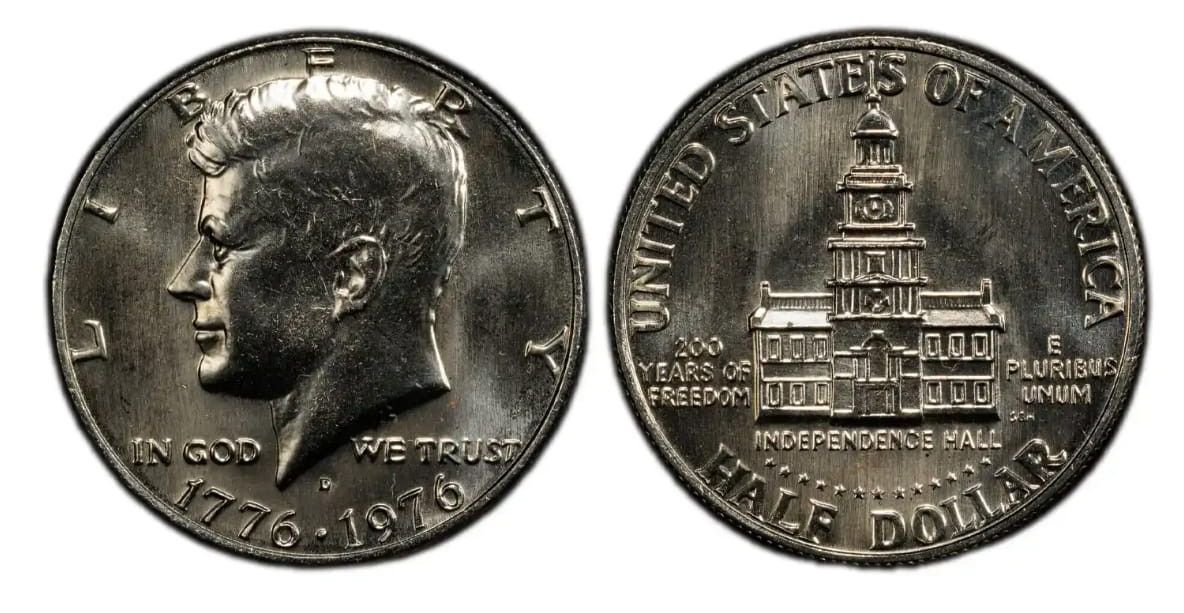
The bicentennial half dollar program was extraordinary in scope. The U.S. Mint produced coins at three facilities from 1975 to 1976, all bearing the dual date 1776–1976. Philadelphia and Denver struck only clad circulation coins (copper-nickel outer layers bonded to a copper core). San Francisco produced both clad proofs for collector sets and special 40% silver versions — both uncirculated and proof — sold in special mint sets.
The Type 1 and Type 2 reverse distinction is a design variety, not an error. Type 1, with bold block lettering on the reverse, was replaced mid-production by Type 2 with thinner, more refined serif letters because the original design didn't strike up cleanly on proof coins.
Table 2: All 1776–1976 Half Dollar Varieties by Mint & Composition
| Variety | Composition | Weight | Mintage | Typical Circ. Value | Unc. / Proof Value |
|---|---|---|---|---|---|
| 1776-1976 (Philadelphia, no mark) | Clad | 11.34g | 234M+ | $0.50–$1 | $2–$10 |
| 1776-1976-D (Denver) | Clad | 11.34g | 287M+ | $0.50–$1 | $2–$10 |
| 1776-1976-S Clad Proof | Clad Proof | 11.34g | 7.06M | — | $5–$20 |
| 1776-1976-S Silver Unc. | 40% Silver | 11.5g | 4.0M | — | $8–$40 |
| 1776-1976-S Silver Proof ⭐ | 40% Silver Proof | 11.5g | 4.0M | — | $15–$200+ |
| Type 1 Reverse (any mint) | Clad or Silver | — | Early strikes | Slight premium | $10–$50+ unc. |
💡 Type 1 vs Type 2 — Quick Visual Check:
Look at the reverse inscription "HALF DOLLAR." On Type 1, the letters are bold and blocky with flat serifs — they look thick and heavy. On Type 2, the letters are thinner and more refined with traditional serifs. Type 1 coins are slightly scarcer, especially in proof format, and command a modest premium over equivalent Type 2 examples.
1776–1976 Half Dollar Value by Grade
What your coin is actually worth in today's market
Table 3: Clad Half Dollar Value by Grade (Philadelphia & Denver)
| Grade | Condition | Value (Clad) | Notes |
|---|---|---|---|
| Circulated (G–XF) | Worn to lightly worn | $0.50–$1.50 | Face value range |
| AU-55 | About Uncirculated | $1–$3 | Slight wear on high points |
| MS-63 | Choice Uncirculated | $3–$8 | Some bag marks |
| MS-65 | Gem Uncirculated | $10–$25 | Strong luster, minimal marks |
| MS-67 | Superb Gem | $50–$200 | Near-perfect surfaces |
| MS-68+ | Registry Quality | $300–$1,500+ | Extremely rare in clad |
Table 4: Silver Proof Half Dollar Value (1776–1976-S)
| Proof Grade | Type | Value | Notes |
|---|---|---|---|
| PR-65 | Silver | $15–$25 | Minor blemishes |
| PR-67 | Silver | $30–$60 | Near perfect proof |
| PR-68 Cameo | Silver | $60–$150 | Frosted devices, mirror fields |
| PR-69 DCAM | Silver | $150–$400 | Deep cameo contrast, near flawless |
| PR-70 DCAM | Silver | $500–$2,000+ | Perfect — very few exist |
⚠️ Never Clean Your Bicentennial Half Dollar:
No polish, no vinegar, no baking soda. Cleaned coins lose 50–80% of numismatic value instantly — graders identify cleaning under a loupe and it cannot be reversed. A naturally toned example always beats a "shiny" cleaned one at auction.
How to Tell Silver from Clad — in 10 Seconds
The single most important test for any bicentennial half dollar
Only San Francisco ("S" mint mark) struck silver bicentennial half dollars, and they were sold directly to collectors — not for circulation. But over the decades, many have been spent or mixed into coin collections without identification. The edge test takes three seconds and costs nothing.
40% Silver (S Mint)
11.5g
- • Solid white/silver edge — no copper stripe
- • "S" mint mark below Kennedy's neck
- • Sold only in collector sets
- • Worth $8–$2,000+ depending on grade
Clad (P or D Mint)
11.34g
- • Visible copper stripe on the edge
- • No mint mark (P) or "D" mint mark
- • Circulated freely as legal tender
- • Usually worth face value to $5
💡 Quick Test Sequence:
Step 1: Look at the mint mark below Kennedy's neck. "S" = San Francisco = possibly silver. Step 2: Tilt the coin and examine the edge. A copper-colored stripe means clad. A uniformly silver edge means 40% silver. Step 3: Weigh it if still unsure — silver is 11.5g, clad is 11.34g. The difference is small but measurable on a jeweler's scale.
1776–1976 Half Dollar Error List with Pictures
When a bicentennial minting mistake becomes a collector's prize
The massive production volumes required for America's bicentennial celebration — hundreds of millions of coins across three mints — created fertile conditions for minting errors. From dramatic doubled die varieties on silver proof coins to wrong-planchet errors and missing clad layers, the complete error landscape for this coin is rich. Here is the full error list with pictures.
Table 5: 1776–1976 Half Dollar Errors — Complete Value Guide
| Error Type | What to Look For | Value Range | Rarity |
|---|---|---|---|
| Wrong Planchet Error | Wrong weight / diameter | $1,000–$5,000+ | Extremely rare |
| Doubled Die Obverse (DDO) | Doubling on dates 1776-1976, LIBERTY | $100–$3,000+ | Scarce |
| Off-Center Strike | Crescent blank, shifted design | $50–$1,200+ | Uncommon |
| Missing Clad Layer | Copper-colored side (one face) | $150–$800 | Rare |
| Broadstrike Error | Oversized diameter, no rim | $40–$500 | Uncommon |
| Doubled Die Reverse (DDR) | Doubling on Indep. Hall, HALF DOLLAR | $75–$800 | Scarce |
| Clipped Planchet | Missing curved/straight edge section | $30–$300 | Uncommon |
| Strike Through Error | Weakened / missing design area | $20–$400 | Uncommon |
| Repunched Mint Mark (RPM) | Secondary D or S outline | $10–$150 | Uncommon |
| Die Crack | Raised line across coin surface | $5–$150 | Common |
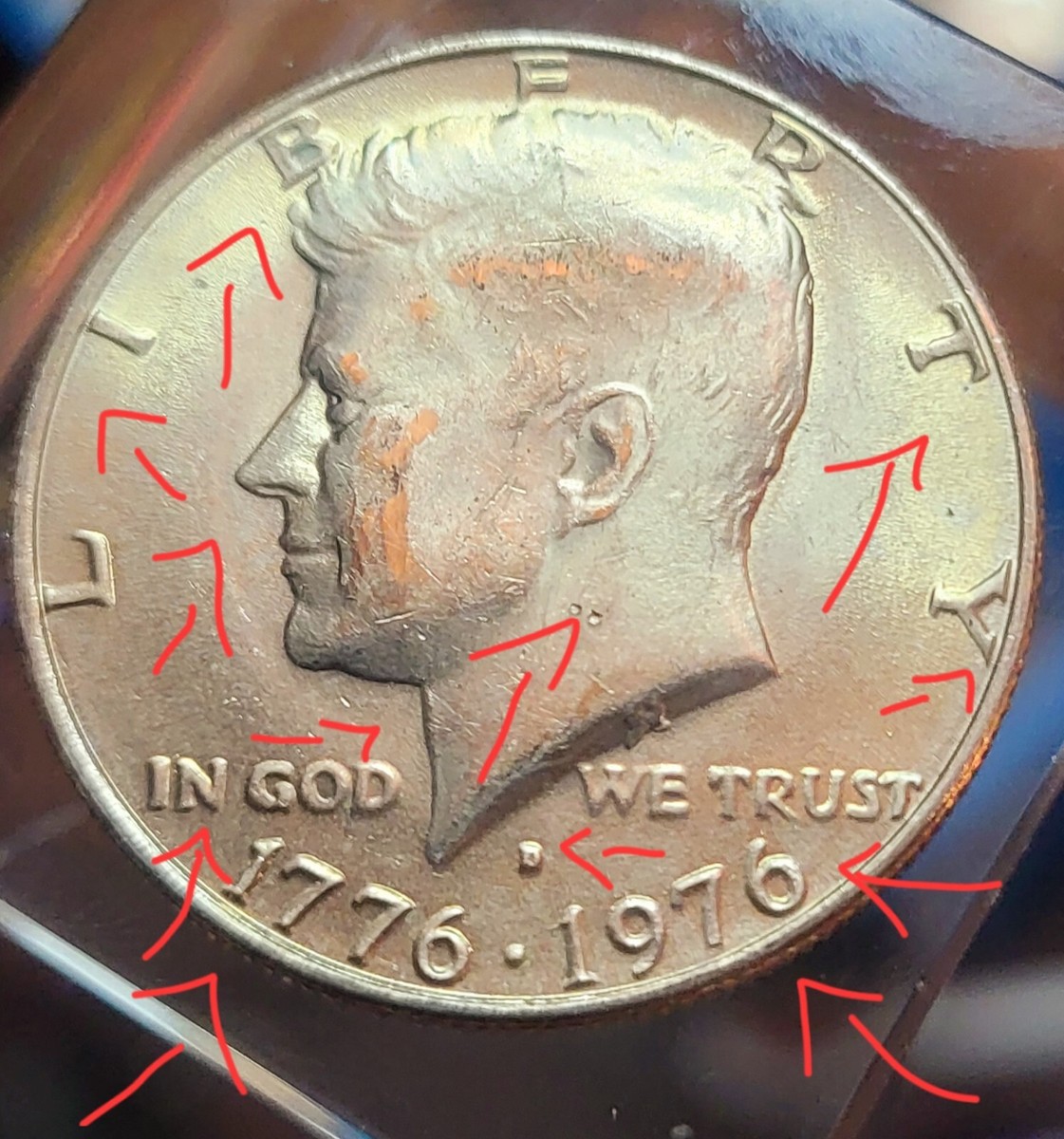
1. Doubled Die Obverse (DDO)
Doubled Die Obverse errors display clear doubling on the front of the coin — most prominently on the dual dates 1776–1976, "LIBERTY," or "IN GOD WE TRUST." This occurs when the hub strikes the working die multiple times in slightly misaligned positions. The most valuable examples come from the San Francisco Mint on silver planchets, where doubling can sometimes be visible to the naked eye. Use at least 10× magnification and look for raised, rounded notching rather than flat mechanical doubling.
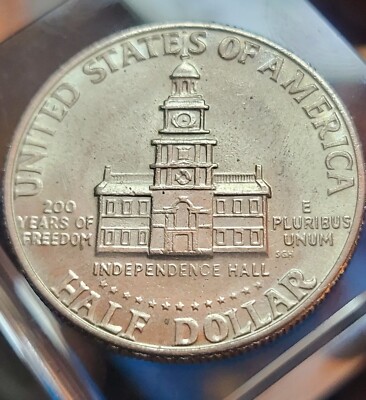
2. Doubled Die Reverse (DDR)
Doubled Die Reverse errors feature doubling on the Independence Hall design, most commonly affecting the windows, architectural columns, "UNITED STATES OF AMERICA," or the "HALF DOLLAR" lettering. Focus your examination on the windows and columns of the Hall, where doubling creates overlapping lines, and on the rim lettering where notched letters are easiest to spot. Both Type 1 and Type 2 reverses can show DDR errors, though they appear differently due to the design variations.
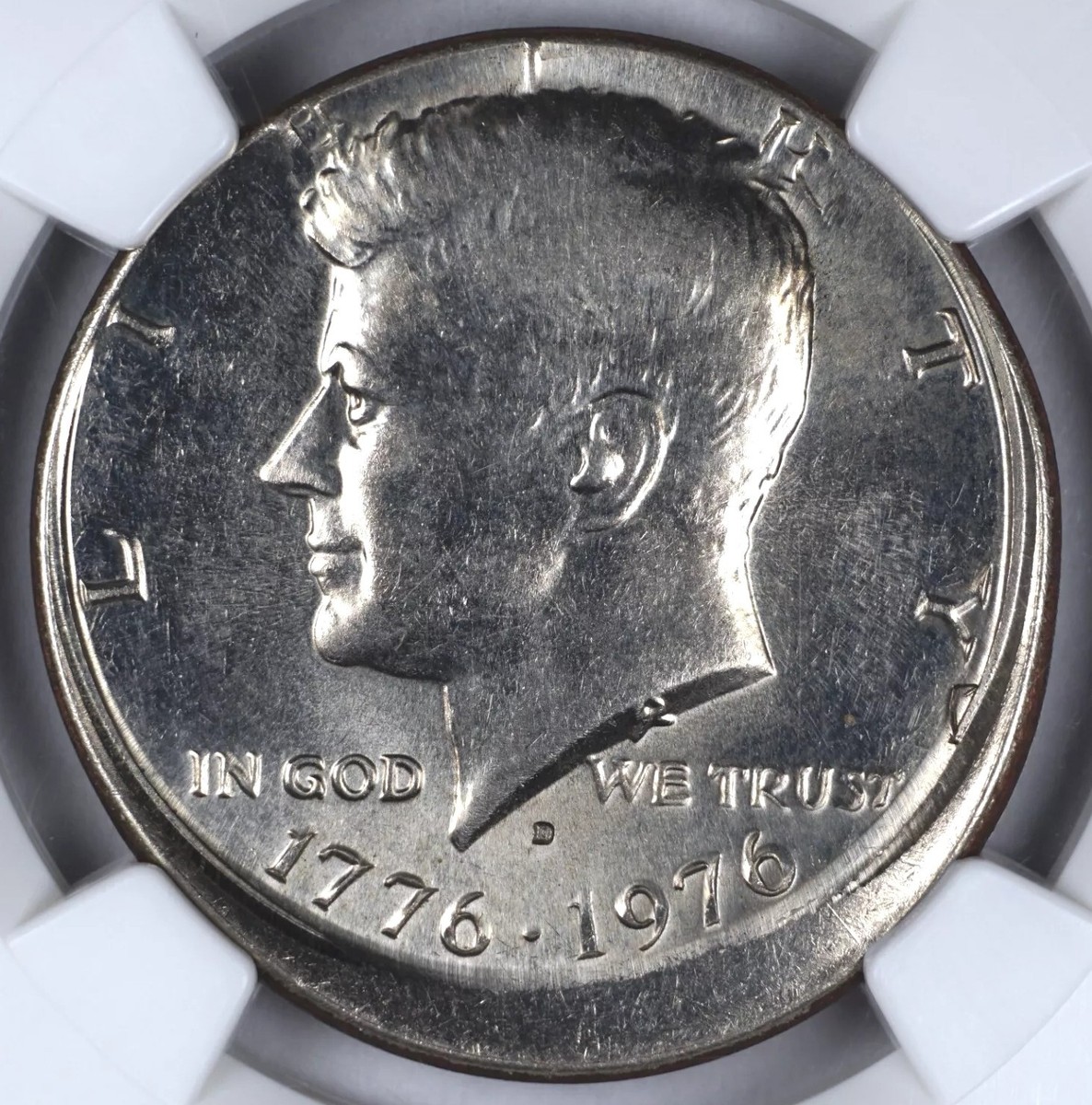
3. Off-Center Strike Error
Off-center strikes occur when the planchet is misaligned with the dies, creating a crescent-shaped blank and a shifted design. The key to value is percentage off-center and whether both dates (1776 and 1976) remain visible. A 30–50% off-center strike with both dates readable is worth substantially more than one where the dates are cut off. Silver composition off-center strikes command significantly higher premiums than clad versions. The raised rim should only appear on the struck portion of the coin.
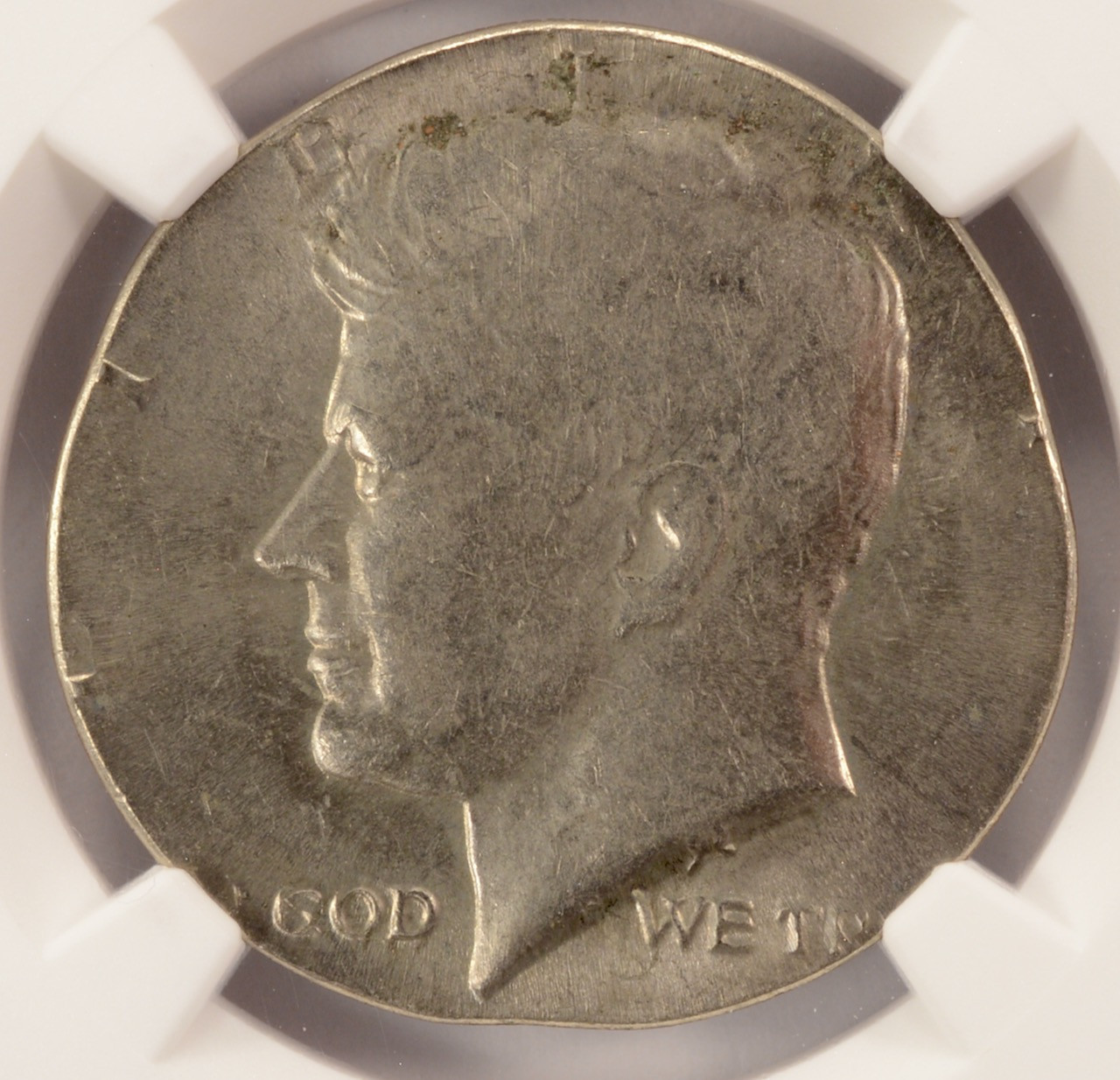
4. Wrong Planchet Error
Among the rarest bicentennial half dollar errors, wrong planchet errors occur when the half dollar dies strike a blank intended for a different denomination. A half dollar struck on a quarter planchet measures approximately 24.3mm (vs. the standard 30.6mm) and weighs about 5.67 grams. The design appears compressed at the edges. Some examples involve foreign coin blanks with unusual weights. Due to the high value and existence of counterfeits, authentication by PCGS or NGC is essential before any sale.
5. Die Crack Error
Die cracks appear as raised lines on the coin surface, caused by metal fatigue in the working die. On bicentennial half dollars, they range from minor hairline cracks to major breaks crossing Kennedy's portrait or the dual dates. Cracks that create "cuds" — raised blank areas where a piece of the die broke away, typically near the rim — command the highest premiums. Distinguish die cracks from scratches: cracks are raised on the coin surface, while scratches are incised into it.
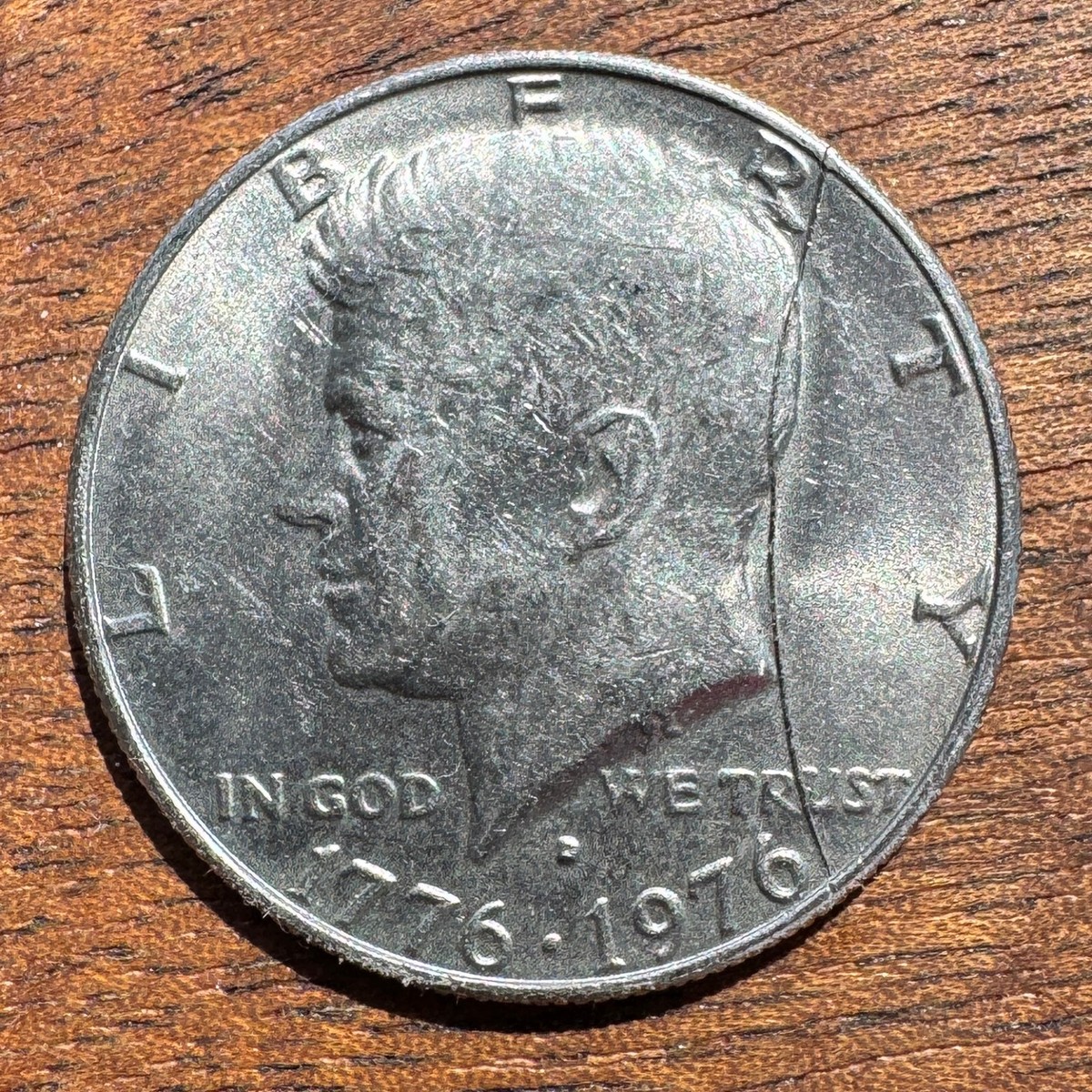
6. Clipped Planchet Error
Clipped planchet errors occur when the coin blank is incompletely punched from the metal strip. Curved clips show an arc matching an adjacent blank; straight clips show a flat edge from the strip's boundary. The rim will be weak or absent in the clipped area — a crucial authentication feature that separates genuine clips from post-strike damage. Larger clips (measured as a percentage of the total coin) command higher premiums. Elliptical clips, created when a blank is punched from an already-clipped area, are particularly rare.
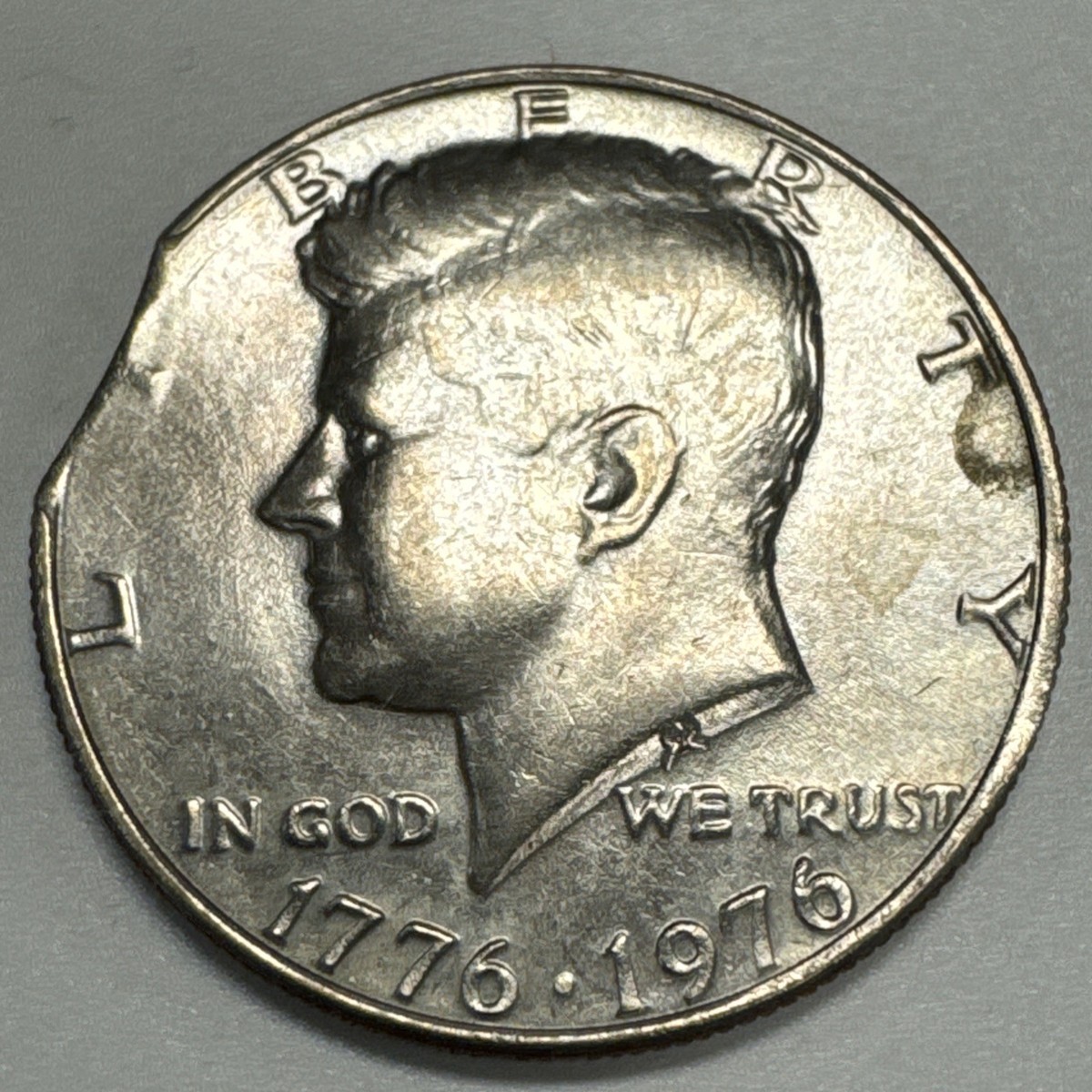
7. Strike Through Error
Strike through errors result when foreign material — grease, cloth fibers, or wire fragments — gets trapped between the die and planchet during striking. The material leaves an impression where the design is weakened, missing, or shows the texture of the intruding object. Strike-throughs affecting Kennedy's portrait or the dual dates are particularly collectible. Distinguish strike-throughs from post-mint damage: genuine examples show the design weakened at surface level, not removed by abrasion.
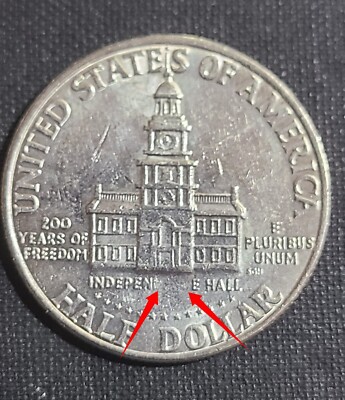
8. Repunched Mint Mark (RPM)
RPM errors occur on D and S mint marked bicentennial half dollars when the mint mark is punched into the working die more than once in slightly different positions. Examine the mint mark below Kennedy's neck with at least 10× magnification — look for secondary outlines, notching, or extra thickness on one side. On 1776–1976-S proof coins, repunched mint marks can be particularly valuable due to the coin's elevated collector status. The most dramatic RPMs show a clearly offset secondary or tertiary mint mark.
9. Missing Clad Layer Error
Missing clad layer errors occur when one or both outer copper-nickel layers fail to bond to the copper core before striking. The affected side appears copper-colored while the opposite side retains its normal silver appearance. The coin will be slightly lighter than the standard 11.34 grams. A genuine missing clad error must show the full design on the exposed copper core — the error occurred before striking, so detail is intact. Coins missing both clad layers are extremely rare. Do not confuse with environmental corrosion or artificially removed plating.
10. Broadstrike Error
Broadstrike errors occur when the coin is struck outside the restraining collar that normally forms the rim and contains the metal. The result is a coin larger than the standard 30.6mm diameter, with no raised rim and a flat, irregular edge. Measure with calipers — broadstrikes typically range from 31mm to 33mm or wider. The design elements appear slightly spread or elongated. Broadstrikes show horizontal striations on the edge from the striking process rather than the vertical reeding of normal half dollars. Broadstruck proof coins are particularly rare.
Real Money: Actual Bicentennial Half Dollar Sales
Not theory. Real coins. Real dollars.
Table 6: Verified 1776–1976 Half Dollar Auction Results
| Coin Details | Auction | Final Price | Why It Sold High |
|---|---|---|---|
| Wrong Planchet Error (on quarter blank) | Heritage / Stack's | $1,000–$5,000+ | Rarest error type — confirmed by NGC/PCGS |
| 1776-1976-S Silver DDO, high grade | Heritage | $500–$3,000 | Silver + doubled die — premium combination |
| Missing Clad Layer | Various | $150–$800 | Dramatic visual error — easy to authenticate |
| Off-Center 40%+, dates visible | eBay / Heritage | $200–$1,200 | Dramatic strike error, both dates readable |
| 1776-1976-S Silver PR-70 DCAM | PCGS Registry | $500–$2,000 | Perfect grade — very few exist |
| Clad MS-68, typical | eBay | $30–$150 | High grade clad — clean surfaces |
"I found a bicentennial half dollar at a yard sale that felt slightly different — lighter than the others. Turned out one face was copper-colored. Missing clad layer error. Graded it at PCGS and sold it for $340. Paid 50 cents for it."
— r/coins user, verified post
Check Your Bicentennial Half Dollars with CoinKnow Coin Identifier App
The fastest way to know what you're holding — before calling an expert
Identifying a bicentennial half dollar error used to require reference books, a dealer's eye, and hours of research. Today, you can point your phone at a coin and get a preliminary identification in seconds. CoinKnow won't replace PCGS grading — but it'll tell you whether it's worth submitting, and help you distinguish Type 1 from Type 2, silver from clad, and genuine errors from post-mint damage, before investing in professional authentication.
Don't let valuable bicentennial half dollars slip through your fingers. Use the CoinKnow Coin Identifier app to instantly identify every variety of the 1776–1976 Kennedy half dollar — including rare silver proof specimens and high-value error coins.
CoinKnow — Coin Identifier
iOS & Android • The #1 Coin ID App for Kennedy Half Dollar Collectors
Instant Recognition
Photograph your bicentennial half dollar and receive immediate identification — mint mark, reverse type, composition, and estimated value in seconds.
Silver vs Clad Guide
CoinKnow walks you through the edge test, weight test, and mint mark identification to determine whether your coin is 40% silver or clad composition.
Error Detection
Side-by-side comparisons help distinguish genuine doubled dies from mechanical doubling, real clipped planchets from damaged edges, and authentic errors from post-mint alterations.
Download CoinKnow Free — Available on Both Platforms


📱 Pro Workflow: CoinKnow + Expert Grading
- Step 1: Check the mint mark — "S" mint is where the valuable silver versions come from
- Step 2: Examine the edge — copper stripe = clad; solid silver = 40% silver (potentially $15–$2,000+)
- Step 3: Use CoinKnow to photograph and identify the reverse type (Type 1 vs Type 2) and check for errors
- Step 4: Check composition with a scale — 11.5g = silver, 11.34g = clad
- Step 5: Review CoinKnow's real-time market values for your specific variety
- Step 6: For any coin potentially worth $200+, submit to PCGS or NGC for professional grading and authentication
The Bottom Line: Your Bicentennial Half Dollar Action Plan
Stop reading. Start checking.
Final Reality Check — 1776–1976 Bicentennial Kennedy Half Dollar
| If Your Bicentennial Half Dollar Has… | It's Probably Worth… | Your Next Step |
|---|---|---|
| Copper stripe on edge, worn or circulated | $0.50–$1.50 | Spend it — it's exactly what it looks like |
| Copper stripe on edge, uncirculated, no errors | $2–$10 | Store in a coin flip — minor collector interest |
| Solid silver edge + "S" mint mark | $8–$40 | Check grade — silver content adds real value |
| Silver + Proof + deep cameo contrast | $50–$2,000 | Submit to PCGS/NGC — grade determines value |
| Visible doubling on dates or LIBERTY | $100–$3,000+ | Do NOT spend — authenticate immediately |
| Wrong weight / wrong diameter 🔥 | $1,000–$5,000+ | DO NOT SPEND. Call PCGS or NGC. Now. |
| Copper-colored face (one side) | $150–$800 | Missing clad layer — weigh and authenticate |
| Oversized, no rim, flat edge | $40–$500 | Broadstrike — measure diameter and submit |
Your 5-Minute Bicentennial Half Dollar Checklist:
- Confirm it's bicentennial — the date must read "1776–1976," not a single year
- Find the mint mark — below Kennedy's neck. S = San Francisco = possibly silver
- Examine the edge — copper stripe = clad. Solid silver edge = 40% silver and worth investigating
- Check the reverse type — bold block "HALF DOLLAR" = Type 1 (slight premium); thinner serif letters = Type 2
- Look for doubling — use a 10× loupe on the dual dates (1776–1976) and LIBERTY. Raised notching = possible DDO
- Use CoinKnow — instant identification, variety detection, and current market value
- Submit to PCGS or NGC — for any coin potentially worth $200+, professional grading is essential
The Bicentennial Half Dollar: A Coin That Still Surprises
The 1776–1976 Kennedy half dollar is one of the most widely collected modern U.S. coins — and one of the most underestimated. Half a billion were minted. Most are worth 50 cents. But the silver versions, the high-grade survivors, and the error coins scattered through that enormous mintage can be worth dozens to thousands of times face value.
What makes bicentennial half dollar collecting compelling is accessibility. These coins still turn up in change jars, bank rolls, and estate collections every day. The edge test, the weight check, and a 10× loupe are all you need to sort the ordinary from the extraordinary — and coin identifier apps have made that process faster than ever.
"Every bicentennial half dollar deserves a three-second edge test. The one with no copper stripe is silver. The one with no rim is a broadstrike. The one with two overlapping dates is a doubled die. America hid its most interesting coins in plain sight."
That's the thing about the 1776–1976 half dollar: it may be the most common commemorative coin in American history. Or the one in your coin jar might be the rarest error in the series. Only a scale, a loupe, and an edge inspection will tell you which.
Found a Bicentennial Half Dollar Worth Checking?
Use CoinKnow for a quick ID, then get professional eyes on anything silver, doubled, or off-spec.
Last updated: 2026 | Values based on PCGS CoinFacts, NGC Coin Explorer, Heritage Auctions, and eBay sold listings
Disclaimer: Coin values are estimates based on recent market data. Actual prices depend on individual coin condition, current buyer demand, and auction timing. Professional grading recommended for coins potentially worth $200+.